Home / Case Studies / 24 HORAS EN…
Reimagining AP® Level Reading Through Real Cities and Authentic Cultural Immersion with the 24 HORAS EN… Collection
Introduction
In this case study, we explore how Diego Ojeda uses the 24 HORAS EN… collection to bring authentic cultural immersion into his upper-level and AP® Spanish classroom—giving students the kind of reading experience that builds interpretive depth, cultural awareness, and genuine confidence with academic-level Spanish.

Diego Ojeda is a Spanish teacher at Louisville Collegiate School in Louisville, Kentucky. A native of Bogotá, Colombia, he is also a comprehensible poetry author, blogger, internationally recognized world language presenter and teacher trainer, and a contributing editor of the REPORTEROS READERS series.
With extensive teaching experience in both Colombia and the United States, his classroom practice emphasizes cultural awareness, meaningful communication, and instructional strategies adaptable to all proficiency levels.
Diego has been incorporating the 24 HORAS EN… Readers in his classes for over a year.

Louisville Collegiate School in Louisville, Kentucky, is an independent, co-educational day school serving approximately 800 students from junior kindergarten through grade 12. Founded in 1915, the school offers a college-preparatory curriculum enriched with arts, athletics, and global learning opportunities, and is the only member of the Global Online Academy in the state of Kentucky.
The Challenge
Teaching AP® Spanish requires texts that can do several things at once. Students need to interpret complex ideas, analyze cultural practices and perspectives, engage in discussion using academic language, build fluency with authentic structures, and prepare for tasks like cultural comparison and persuasive writing. Very few classroom readers support all of these goals effectively.
In reviewing potential AP®-level readers over the years, Diego consistently ran into the same shortcomings.
- A thin market at the advanced level. Publishers offer plenty of choices for Levels 1–3, but options for advanced and AP® courses are far more limited. Teachers end up choosing between texts that are too simplistic and texts that feel disconnected from classroom realities.
- A linguistic balancing act that most readers get wrong. Some advanced readers are so dense with unfamiliar vocabulary and complex syntax that they interrupt reading flow entirely. Others are so heavily controlled that they strip away the authentic rhythm and academic tone students actually need. In either case, students aren’t encountering the kind of nuanced language required for higher-level analysis.
- Culture treated as decoration. Many readers present culture in isolated segments—short informational paragraphs, brief notes about landmarks and festivals. While informative, these additions feel external to the narrative. AP® students need more than cultural facts. They need exposure to lived realities, urban complexity, and diverse perspectives that can serve as evidence in analytical tasks.
- Academic rigor without narrative pull. Even advanced students benefit from compelling storytelling. Some texts are academically appropriate but emotionally flat. Without narrative momentum, students read to complete an assignment rather than to engage with content—and the result is limited retention and missed opportunities for meaningful discussion.

"Throughout my career, I examined many potential AP®-level readers, searching for texts that could truly meet the intellectual and linguistic demands of advanced students. While the U.S. market is rich in options for beginning and intermediate levels, there is a noticeable gap when it comes to high-quality readers designed specifically for upper-level and AP® courses."
Diego Ojeda
The Solution
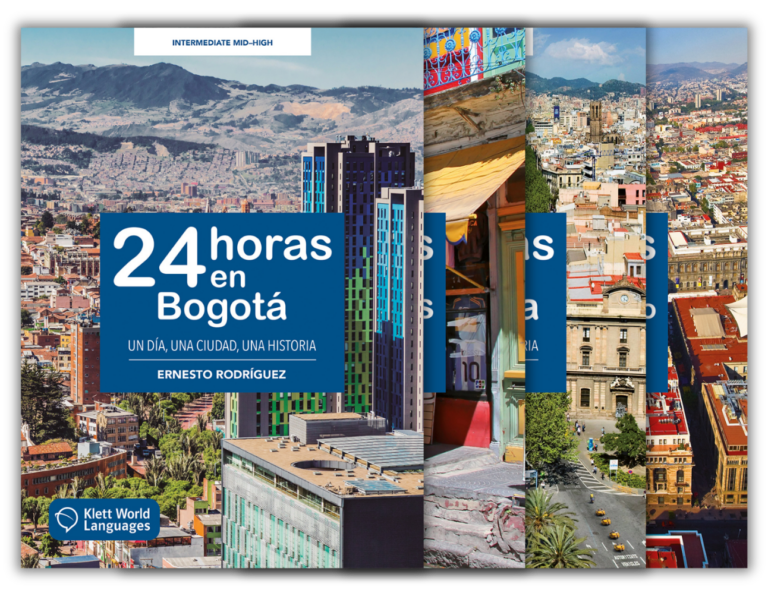
The 24 HORAS EN… collection reframes cultural reading by immersing students in a full day inside a real Spanish-speaking city. Rather than presenting culture as description, these books present culture as lived experience. Students explore cities including Ciudad de México, Bogotá, Buenos Aires, and Barcelona through a chronological narrative that follows the events of one day, hour by hour.
Real Culture, Real Cities
Students don’t simply learn about these cities—they move through them. They ride public transportation, visit neighborhoods and markets, interact with family and friends, experience local cuisine, and encounter historical and contemporary references woven naturally into daily routines and social interactions. This immersive approach provides rich material for AP®-style cultural comparisons and thematic analysis.
Engaging Short Narratives
The “one day” structure creates natural momentum. The unfolding of events keeps students curious and engaged, and because each narrative is manageable in length, teachers can conduct close readings, facilitate thematic discussions, assign interpretive tasks, and build toward analytical writing. The narrative design supports both fluency and rigor simultaneously.
Comprehensible Yet Authentic Language
The language strikes a careful balance—accessible enough to maintain reading flow, yet authentic enough to expose students to idiomatic expressions, urban vocabulary, and natural dialogue. Students experience success because they can understand the text, and that confidence allows them to focus not just on decoding language but on analyzing meaning. In advanced classrooms, comprehension becomes the foundation for interpretation.
Visual Dictionaries to Support Independence
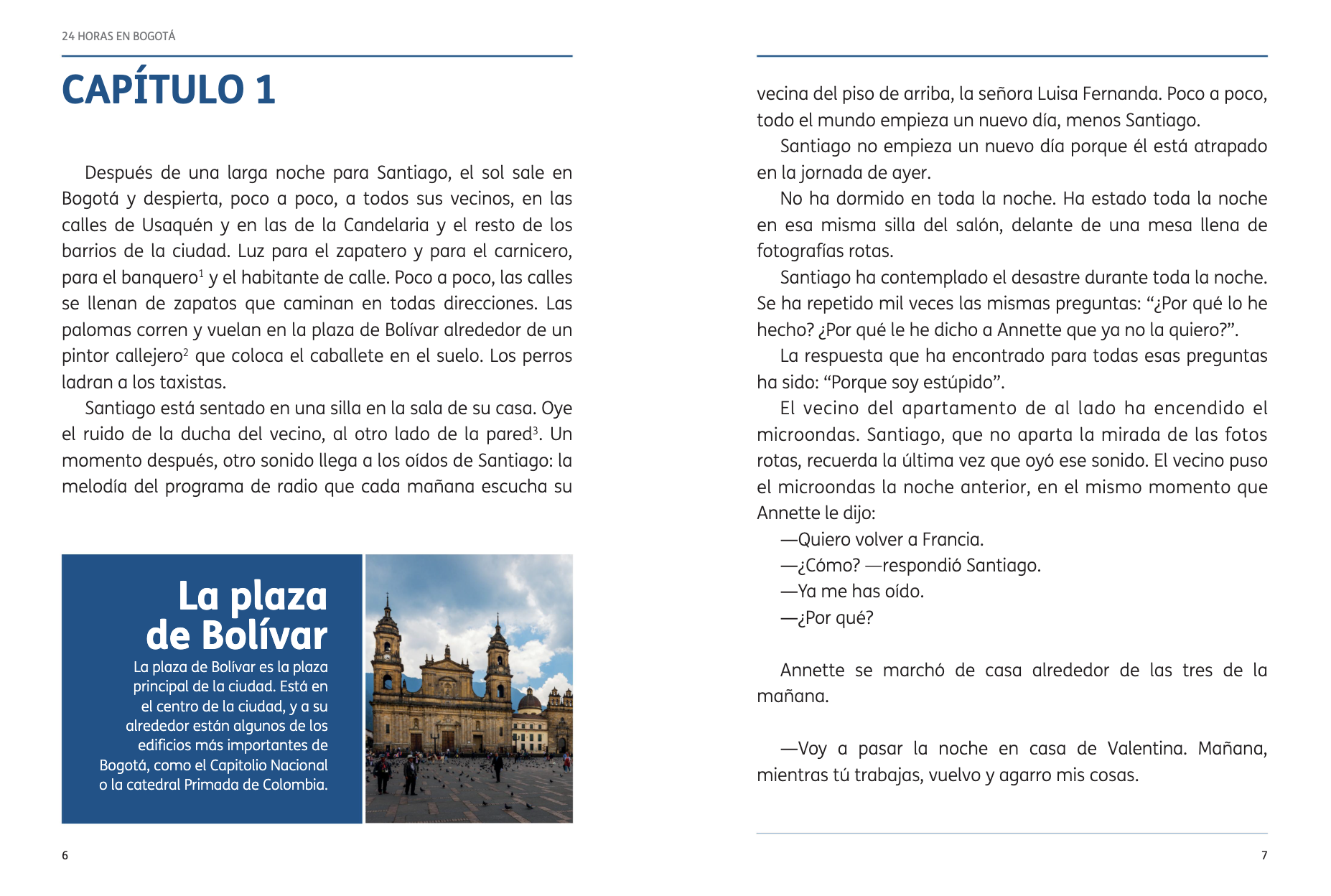
Each book includes illustrated word banks that reinforce vocabulary acquisition, reduce cognitive overload, encourage contextual inference, and minimize constant dictionary interruption. By maintaining reading flow, students build the stamina and confidence that are essential for AP®-level interpretive tasks.
Built-In Cultural Connections
The books highlight local cuisine, historical landmarks, traditions and celebrations, urban realities, and contemporary social contexts. These embedded cultural elements naturally support classroom expansion into products, practices, and perspectives discussions; regional diversity analysis; interdisciplinary connections; and comparative analysis. Teachers can build directly from the narrative rather than layering on supplemental culture lessons.
Integrated Language Practice
The collection includes activities that reinforce vocabulary, reading comprehension, and cultural understanding. These built-in supports make implementation efficient and allow teachers to focus on deeper discussion and application.
"AP® students need more than cultural facts. They need exposure to lived realities, urban complexity, and diverse perspectives that can serve as evidence in analytical tasks."
Diego Ojeda
Impact on Students and Learning Outcomes
Since integrating the 24 horas en… collection into his upper-level classes, Diego has observed a clear shift in how students engage with Spanish-language reading. Students demonstrate increased curiosity about Spanish-speaking cities, participate more actively in discussions, and bring more nuance to cultural conversations.
Interpretive reading skills have strengthened, and students show greater confidence when analyzing cultural perspectives. They’ve begun to see cities not as abstract geographical names but as dynamic, lived environments shaped by history, community, and daily routines.
Most importantly, reading has become immersive rather than mechanical. The combination of authentic cultural immersion, narrative momentum, and accessible language gives AP® students something rare: reading material that challenges them intellectually while keeping them genuinely engaged.
"Advanced-level reading does not need to sacrifice engagement in order to achieve rigor. These books help bridge the gap that exists in the U.S. readers' market for upper-level and AP® classrooms. They invite students not only to read Spanish, but to experience it."
DIEGO OJEDA
Learn more about the 24 HORAS EN… series by visiting the link below.